
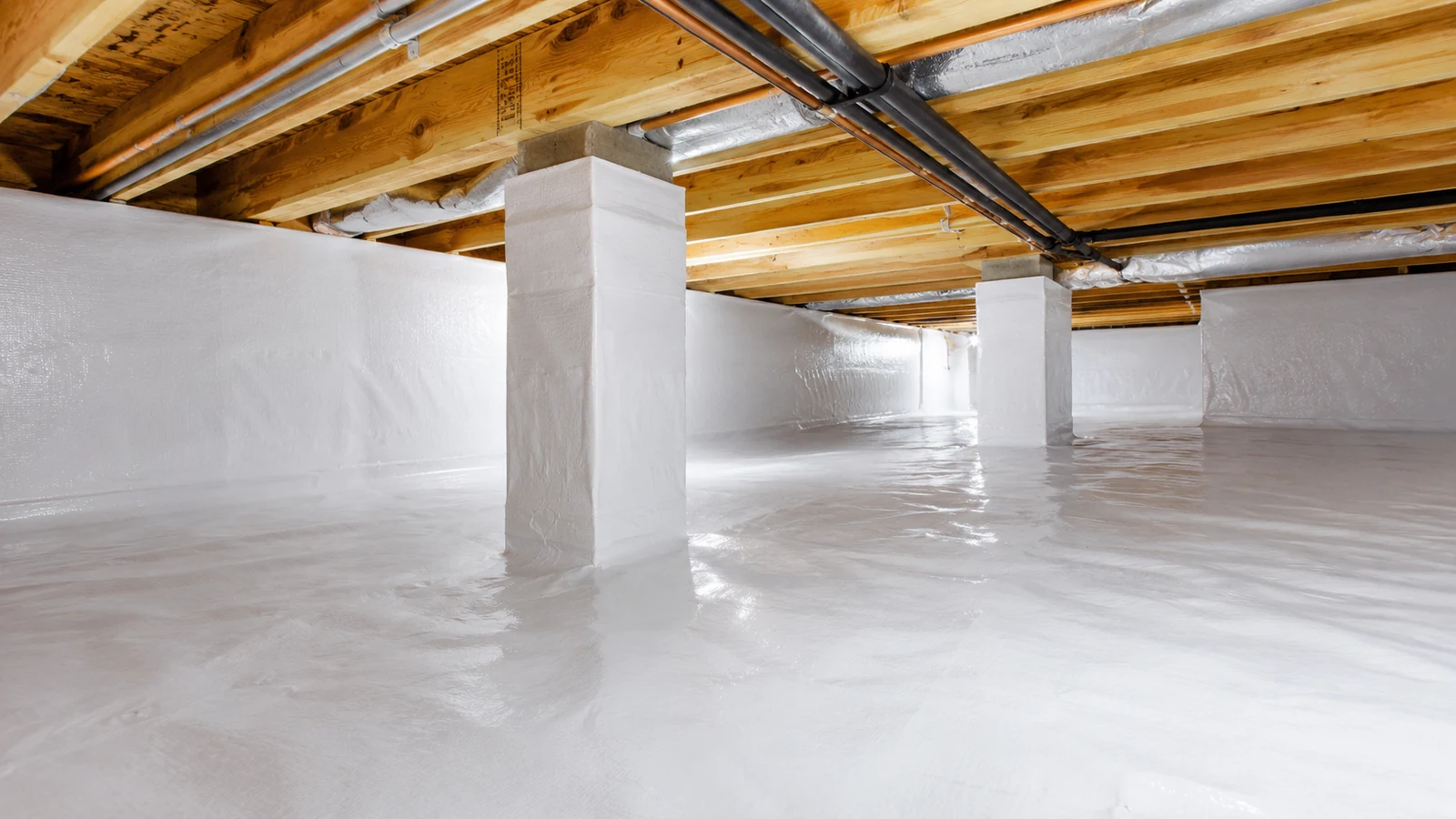
Homeowners searching crawl space options in Savannah often encounter two terms — vapor barrier and encapsulation — used almost interchangeably by contractors and websites. They are not the same thing. Here is what each actually means, what each costs to address, and how to decide which one your home needs.
What a vapor barrier is
A vapor barrier is a liner — typically plastic sheeting — installed across the exposed soil floor of a crawl space. Its purpose is to block ground-source moisture from evaporating into the crawl space air. It is the foundational component of any crawl space moisture control system. Vapor barriers range from thin 6-mil poly sheets to heavy-duty reinforced liners 20 mils thick or more.
What encapsulation is
Encapsulation takes the vapor barrier concept and extends it into a complete system. A fully encapsulated crawl space includes a heavy-duty floor liner, liner on the walls, pier wrapping, sealed foundation vents, improved or sealed access doors, and typically a crawl space dehumidifier to control humidity in the sealed environment. The crawl space becomes a conditioned space rather than an open, vented one.
The cost difference in Savannah
A vapor barrier installation on a clean crawl space with no drainage issues is less expensive than full encapsulation. Full encapsulation costs more because it involves more materials, more labor, vent sealing, and often a dehumidifier. The right choice depends on what problem you are actually solving — not just which sounds better in marketing materials.
When a vapor barrier is enough
A vapor barrier alone may be sufficient if: your crawl space has no history of standing water, ambient humidity is moderate, existing insulation is in good condition, vents are functioning properly, and you are addressing a ground-moisture concern in a crawl space that otherwise functions well. This is more common in Pooler, Richmond Hill, and newer construction where drainage is better managed.
When full encapsulation is the right call
Full encapsulation makes more sense when: humidity readings are consistently high, there is a history of water intrusion or odor, insulation has failed, the home is older and has open vents, or you want a long-term sealed system that does not rely on outdoor air to manage moisture. In Savannah's core historic neighborhoods — particularly older homes near low-lying areas — encapsulation is often the more durable choice.
The dehumidifier question
A sealed crawl space without mechanical dehumidification can accumulate humidity, especially in Savannah summers. A dehumidifier installed inside the sealed space adds equipment and installation cost but is often what makes the difference between a crawl space that stays at 50% humidity and one that climbs to 70% in August. Ask your provider whether they recommend it and why.
For a deeper look at the options, see our pages on vapor barrier installation and full encapsulation.